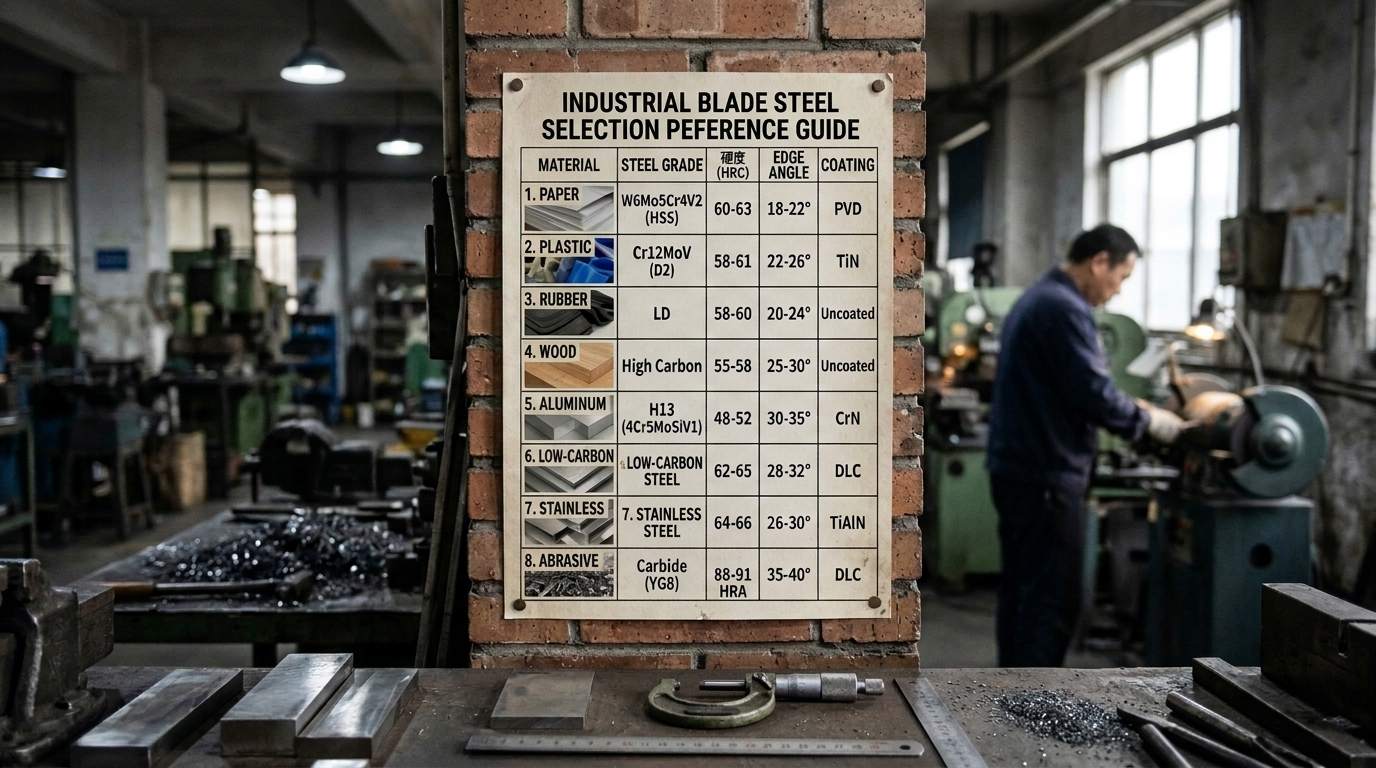
Someone rings up and asks for “the best blade steel” without saying what they cut. That question has no answer — and it’s the one we get most. Paper filled with clay abrasive, sticky plastic film, rubber with steel wire in it, and 25 mm stainless plate each wreck an edge in a completely different way, so the steel mill shear blade grades that are perfect for the plate will gum up or chip on the other three. Start from the material being cut, not the steel catalogue, and pick grade, hardness, edge angle and coating in that order. The table below maps the nine feeds we see most often to a working spec — it’s the short version of what our engineers ask before quoting anything.
Key Takeaways
- Abrasiveness, stickiness and shock are the three drivers. Everything else is detail.
- D2 at 58–62 HRC covers most clean metal work. Move to M2 or H13 for gummy stainless and abrasive scrap, to 440C or DLC-coated D2 for plastics.
- Softer feeds need sharper edges (25–40°), abrasive and thick feeds need blunter ones (45–60°).
- Coatings are chosen by stickiness, not hardness. DLC stops build-up; TiCN handles abrasion.
- Maximum hardness is rarely the answer — a blade that is too hard chips on shock loads.
What Actually Changes When the Material Changes?
Three things, and they pull the spec in different directions:
- Abrasiveness — clay-filled paper, cast iron, AR plate and gritty scrap grind the edge away. Push hardness and wear resistance up.
- Stickiness — film, rubber, aluminium and 304 stainless smear or gall on the edge. Here a low-friction coating does more than another 2 HRC.
- Shock — mixed scrap and demolition work hit the edge unpredictably. Trade a little hardness for toughness or it will chip.
Which Blade Steel Fits Paper, Plastic, Rubber, Wood and Metal?
Read the left column, take the rest of the row. These are working ranges we quote from, not laboratory figures — confirm the final hardness against your own duty cycle:
| Material you cut | Grade | HRC | Edge angle | Coating |
|---|---|---|---|---|
| Paper / cardboard (filled) | D2 or M2 | 58–62 | 25–35° | Optional TiN |
| Plastic film / sheet | 440C or D2 | 56–60 | 30–40° | DLC |
| Rubber / tire with wire | D2 or M2 | 58–62 | 35–45° | DLC |
| Wood / biomass | D2 or A2 | 57–60 | 30–40° | Optional TiCN |
| Aluminium / copper | D2 or 440C | 58–60 | 25–35° | DLC |
| Mild / low-carbon steel | D2 | 58–62 | 40–55° | Optional TiCN |
| Stainless 304 / 316 | M2 | 60–63 | 40–55° | DLC |
| AR / Hardox / cast iron | M2, H13 or carbide | 62–65 | 45–60° | TiCN |
| Tire wire / mixed scrap | D2 + DLC or H13 | 58–62 | 45–60° | DLC |
The non-metal rows are where people get caught out. Film and rubber don’t blunt an edge so much as coat it, and once material builds up the cut turns to tearing — a shredder blade for plastics needs the low-friction finish more than it needs extra hardness. A harder plain D2 will actually perform worse there.
What Should You Change When the Blade Fails Early?
Rather than re-speccing from scratch, read the symptom. It usually points to one row of the table above:
| What you see | Likely cause | Move to |
|---|---|---|
| Edge rounds off fast, no chips | Abrasive feed, hardness too low | M2 / carbide, 62–65 HRC, TiCN |
| Material stuck to the edge | Gummy feed, no coating | DLC-coated grade, sharper angle |
| Small chips along the edge | Shock load, blade too hard | H13 or lower HRC, blunter 45–60° |
| Long burr on the cut face | Clearance or edge angle wrong | Reset clearance first, then re-spec grade |
How Do You Spec a Blade From the Material You Cut?
Four lines on a purchase order do the job. Send these and you’ll get a blade that fits first time:
- What you cut and how thick — name the actual grade (304 stainless, AR400, filled cardboard), not just “metal”.
- Machine and duty cycle — shear or rotor, tons per shift, how often you stop.
- How the last blade failed — worn round, chipped, or gummed up. That single answer picks the row.
- A sample or drawing with hardness noted, so the supplier can confirm the scrap gantry shear blade steel and heat treatment before volume.
Where Do Non-Metal Jobs Fit a Heavy-Duty Blade Shop?
Honestly, paper and film converting knives are not our main line — GOOD-KNIFE builds blades and moulds for metal shearing, shredding and recycling. But buyers running mixed waste streams ask us about plastic, rubber and wire every week, and the steel logic is the same, so we publish the full map rather than pretend the question stops at steel. If your feed is mostly metal or mixed scrap, send us the material list and a worn blade; we’ll reverse-engineer the grade and heat treatment and return a measured certificate before you order.
FAQ
What blade steel should you use for cutting plastic film?
Use 440C or D2 at 56–60 HRC with a DLC coating and a 30–40° edge. Film fails by sticking and melting onto the edge, not by blunting it, so the low-friction coating matters more than maximum hardness. A plain hard D2 blade will load up and start tearing rather than cutting.
Is D2 good enough for cutting stainless steel?
D2 works, but M2 at 60–63 HRC with DLC is the better call for 304 and 316. Stainless work-hardens and galls, so you need a tougher, hotter-hardness grade plus a low-friction surface. Uncoated D2 tends to smear and load up on stainless long before it wears out.
Why does paper wear out a blade so fast?
Because of the filler, not the fibre. Clay, calcium carbonate and recycled grit are abrasive, so a paper blade dulls the way a metal blade does on cast iron. That’s why filled board wants D2 or M2 at 58–62 HRC with a keen 25–35° edge, and why clean kraft paper is much kinder.
Can one blade grade handle both mixed scrap and clean plate?
Rarely. Clean plate wants D2 at 58–62 HRC with a 40–55° edge and tight clearance; mixed scrap brings shock and abrasion that call for H13 or M2, a blunter 45–60° edge and wider clearance. If you must run both, spec for the worse feed and accept shorter life on the clean work.
What hardness should a blade be for cutting aluminium?
58–60 HRC on D2 or 440C, with a sharp 25–35° edge and a DLC or polished finish. Aluminium is soft and prone to built-up edge, so going harder buys nothing — keeping the edge keen and slippery is what stops the metal welding to it.
There is no universal “best” blade steel — there is only the right row for what you cut. Name the material, check the failure mode of your last blade, and let the table pick grade, hardness, angle and coating. GOOD-KNIFE engineers blades to the drawn profile and a measured hardness certificate, mainly for metal shearing, shredding and recycling lines — see the full range at GOOD-KNIFE or send us your material list and a worn sample to start.